Wednesday, 4 January 2012

Ansel Adams

Ansel Adams (1902 - 1984) is considered by many to be America's greatest landscape photographer. He was influenced by Paul Strand which gave rise to an interest in 'pure' photography. His photographs are characterised by use of a small aperture to give pin point clear images with a great depth of field.He was also knowledgeable on the science of photography, creating in 1941 the 'zone system' which was an aid to determine correct exposure and development times.
He is most famous for his photographs of the beauty of his native North America but was also a keen photographer of trees, often producing striking black and white images.

The images I show below are copied from:

Ansel Adams. Trees. The Trustees of the Ansel Adams Publishing Rights Trust. 2004. Little Brown and Company, New York. ISBN 0-8212-7752-9

Page 9.

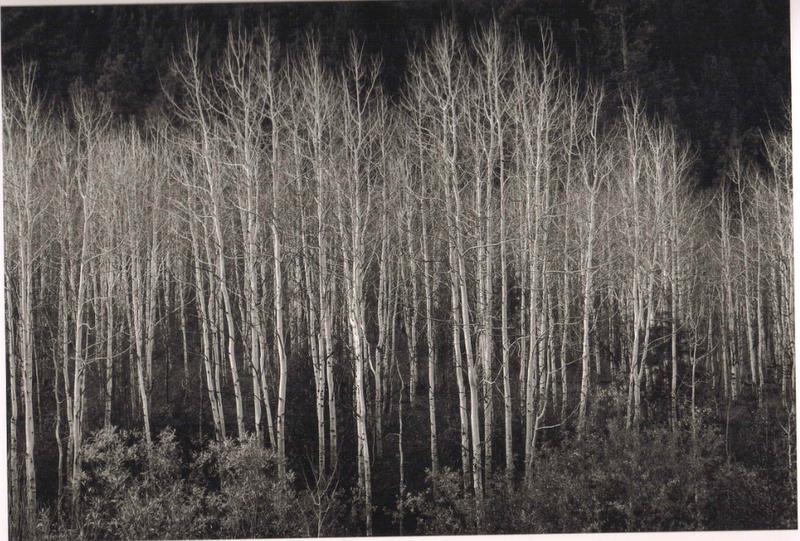
Aspens, Northern New Mexico. 1958.

This photograph was taken “on a crisp autumn day in the mountains north of Santa Fe ... We were in the shadow of the mountains, the light was cool and quiet and no wind was stirring. The aspen trunks were slightly greenish and the leaves were a vibrant yellow. The forest floor was covered with a tangle of russet shrubs. It was very quiet and visually soft ... I visualised the images as stronger, in accord with the mood of the hour and the place.”  (Ansel Adams, from ‘Examples: The Making of 40 Photographs’.)

Page 97
Aspens, Dawn, Delores River Canyon, Colorado. 1937


Page 13

Road and Fog, Del Monte Forest, Pebble Beach, California. 1964


The common denominator for me of all these images is the sheer vertical uprightness of all these trees. I suspect the maximum lean is 5 degrees. Add this to the use of black and white gives a solidity and strength to all the images.

The 3 images are tremendously varied. On Page 9 the softness of the shrub is shown not only by the presence of leaves highlighted dramatically in the light but the contrasting  'round' shape. The visual tone is immense from the near black of the forest to the almost white of the leaves. When you read Adams' comments you realise that he has enhanced thisphotograph to create an image more in keeping with moonlight and nighttime.  An image of power.

The second image on Page 97 appears softer to me. The dawn light has caught most of the aspens, although hints of more can be seen in the background. The trees draw you in to the forest - they do not appear harsh or threatening. This effect is because of the bright dawn sunlight - probably 30 minutes later and the image would be flatter as more trees were illuminated, possibly with a background.

The third image in the fog is softer again. The image is more 'open'; the track leads you into the image to see what is beyond the bend. The fog adds a softness which bright sunlight could not although the image is far from dark, and totally non-threatening. The obscurity caused by the effect leaves you questioning - what is down the track, amongst and beyond those trees.

In order for the images to work in black and white they must have sharp lines and shapes - which is certainly the case. However Adams' great strengt is his use of light to evoke mood.


I am also showing an image of my own, taken on an autumn afternoon.


f/16; ISO 200; 1/80 second; focal length 40 mm

How does my image compare? Well there are many differences:
     fewer trees
     less upright with deeper angles
     colour not black and white
     closer
     more cluttered

However I believe the influence can be seen. Certainly after seeing such images by Adams I became more aware of trees as shapes - especially vertical lines. Possibly a wider lens may improve the image by including the tree tops (my wide angle lens is currently faulty); possibly I could shoot from a lower perspective to give a greater impression of height. The garden itself limits the distance from which I can shoot any image. The light is harsher than that used by Adams, and yet the gradations of colour from near violet to blue within the sky gives a beauty of its own.
Technically a lower ISO (100) and smaller aperture (f/22) to maximise depth of field would also improve the image. The use of a tripod to enable use of the slowest possible shutter speed might have enabled this.

This image is not the finished article, but gives a direction in which to travel.


Thursday, 22 December 2011

Comparison of my photographs with one taken by Paul Strand


This is the original image taken by Paul Strand of wild irises. It is a strong image which despite being monochromatic has a wide range of tones, giving depth and texture to the image.


The images below are my own, which have been converted automatically to black and white within Photoshop. I chose this simple method so that I could evaluate my photos in comparison to the original by Paul Strand.


This first image is I believe quite strong with definitive lines. However it has a narrow range of tone and for this reason appears very flat and lacking in texture. With a more sympathetic conversion in Photoshop the tonal range could probably be improved.


This second image has an improved tonal range, but insufficient leaves are in focus with the result that the image is less powerful in black and white. This image is better in colour.

I intend to try to 'improve' the first of my 2 images within Photoshop and re-evaluate.


Thursday, 15 December 2011

Reference Sources Used

Photographing Wildlife. Marianne Taylor and Steve Young. 2009. New Holland Publishers. ISBN 978-1-84773-486-0

Contemporary Photography and the Garden - Deceits and Fantasies. Thomas Padon with Robert Harrison, Ronald Jones, and Shirin Neshat. 2004. Harry N.Abrams Inc Publishers, in association with the Americal Federation of Arts. ISBN 0-8109-4955-5

Collins Complete Photography Course. John Garrett and Graeme Harrris. 2008. Harper Collins Publishers. ISBN 978-0-00-727992-0

Get the most from your digital SLR. The Digital SLR Guide. Chris Roberts. 2008. Downloaded from the Internet March 2009.

Ansel Adams. Trees. The Trustees of the Ansel Adams Publishing Rights Trust. 2004. Little Brown and Company, New York. ISBN 0-8212-7752-9

Landscape and Nature Photography. Richard Muir. 1986. George Philip, London.ISBN 0-540-01100-2

The Digital photographer's A-Z. Peter Cope. 2002.Thames and Hudson, London. ISBN 0-500-54247-3


Reflection on Catherine Opie: Four images of the Garden

The photographs below were all taken by Catherine Opie in 2000, and were specially commissioned for a travelling exhibition organised by the American Federation of Arts entitled 'Contemporary Photography and the Garden - Deceits and Fantasies'. Opie visited a wide variety of gardens across the United States varying from the formal, to the inner city to a men's prison. Her purpose was to investigate ' what commonalities would emerge in a construct as intellectually elevated as a garden' whilst capturing the 'ordinary moment'.

Catherin Opie (born 1961) is a contemporary American photographer who at the age of nine stated that she wished to be a 'social documentary photographer'. Her stated aim is "to capture America, in faces and on streets, from the centre to the fringe, in ways that are stylised, shocking and everyday". Many of her self-portrait images from the 1990s are indeed difficult and shocking. ( “Self-Portrait /Pervert” (1994);  "Self Portrait /Cutting" (1993))


Below are 4 images scanned from 'Contemporary Photography and the Garden - Deceits and Fantasies'.

The first three form a triptych and as such should be viewed together; all are sized 30 x 40 inches.


Untitled, 2000 (Triptych)
This image has the trunk dead centre, and this draws your eye to it. The branches pull you up and round, whilst the overexposed lawn at the back draws you back from where you can explore the mirror image of the shadows. I believe it is the shadows and their clarity that make this image so special. It has been taken in full sunlight, when conventional wisdom states you DO NOT take photographs; but the canopy of the tree softens the light which is so essential for the shadows. The adjective for the colours is 'natural', hence they complement each other perfectly with the light lifting all the dark colours out of the 'sombre' zone.


Untitled, 2000 (Triptych)
I find this a most clever image. The water tap lies centre front, dominating the image. The dullness of the green tap and hose are lifted by the yellow of the sprinkler. Immediately behind the rough path acts as a leading line to take you into the picture. You see the neat rows of vegetables - more shades of green, but so varied. From there the sheds - this is a man made image and the sheds reinforce this. Behind lie the more natural trees, the only area bathed in sunlight. I am sure there is allegory here. An image both exceedingly ordinary and thought provoking at the same time. Wonderful!


Untitled, 2000 (Triptych)
Yet another image where green ids the dominant colour - yet the use of light highlights all the varying shades possible within the nature of green. The central ivy appears unsupported and acts as the leading line into the photo. The light space to its left allows your eye to move down with the trees at the far left back acting as a frame. On the right is another tree in the mid-distance which is paler and separate, again allowing the eye to return, with the thin trunk and dark ivy pulling the eye back to the starting point, whilst passing just visible man's influence - the house! A restful image one familiar to so many of us where we can use our own memories to re-enter our mind.

Comments on the Triptych
Three most 'ordinary' subjects, each amazingly different. Were they from the same garden? No clues there. For me the first image shows the majesty of nature itself with the dominant tree trunk; the second the effect of man in the vegetable garden; the third the peace and tranquillity of mind to be found within the garden.


Untitled, 2000 ; 30 x 40 inches
This fourth image is obviously taken in an urban setting - a park or garden. The contrasts between the buds in the foreground, and the flowers of the shrub behind (slightly out of focus) are quite exciting - Spring in all her glory is shown here. Behind we have the urban dwellings - not intrusive but an essential contrast. The beauty of nature is highlighted by the buildings. There is even the beginning or end of a spider's web - what a tale to be told there.
The colours complement well, with the red flowers being an essential feature. The sapling in the foreground provides the highlight and the leading line, with the pole behind it emphasising this and drawing the eye to the buildings. The spider's web draws the eye back; the darkness of the building on the right and the shrub to the left acting as frameworks to once more draw your eye away from the dull sky and back to the beautifully focused sapling.


In conclusion:
These images epitomise to me what I would like to achieve. They are honest with a love and respect for the subject, conveying the perceived 'place' of the subject within the garden spac - indeed the 'ordinary moments'. I hope to be able to emulate these effects within my own images - time and weather permitting!


Saturday, 10 December 2011

Reflection on Paul Strand, and Four Garden Images.

Recently Steve lent me a beautiful book of photography:
Contemporary Photography and the Garden  - Deceits and Fantasies.
Within this book was a single image by Paul Strand (Photo 4 below) - a deceptively simple black and white photo of columbine. Having seen this I decided to investigate the work of Paul Strand.

Paul Strand lived from 1890 to 1976, being introduced to photography in 1907 and working as a commercial photographer. In the 1930s and 1940s his main interest was socialist documentary, both with still film and the cinema. From 1945 to his death was his most productive period. He settled in France and travelled extensively taking photos of working people. It is during this period that most of his works of nature were produced, many being taken in his garden in France.

In 1917 Paul Strand said that if one were to use photography honestly he must have "a real respect for the thing in front of him".
This to me seems so self evident that I was amazed to read the statement, and partially explains the reason for my choice of themes. My own sense of this is that for my photography to have meaning I must have not only an interest but also an emotional bond with the subject. Thus although I loath wasps with a passion, I can photograph them as they both fascinate and repel me.


The four images below are all in black and white:


Wild iris, Maine.
I do not know the date for this photograph, but possibly since it was taken in America it may be from the 1920s.
The leaves of the iris dominate most of the picture, with the ferns weaving in at the top. The image is unusual as it is lit from the bottom centre, and it is to this point that your eye is initially drawn and then upwards and outwards with the leaves; the ferns at the top then pull your eyes to the right and down, from where you re-enter the image once more. The depth of field is very large, so that the edges of the iris leaves have complete clarity; the darkness immediately behind them gives an impression of depth and solidity to the leaves. The ferns in contrast have less clear edges and appear more frail - which in truth they are of course. This creates a great feeling of texture and contrasting tones, enhanced by the starkness of black and white. The only leaf that is out of focus is the bent central leaf where the image begins - perhaps to pass you beyond that point and upwards into the main photo. Why can this image work in black and white? It's simplicity and lack of clutter, and the immensely powerful lines of the iris leaves.
I have several images of similar leaves in my own garden where I have focused on the colour of the seeds. In a future blog I hope to compare them with this image.


Journeys in land of the morning calm.
Again I do not know when this image was taken, nor where. In this image your eye is drawn to the upper side of the mushroom since it is so light and dominant in the image. From there you go back into the image by following the ivy leaves into the darkness, and then following the darkness to the stalk of the mushroom. At this point your eyes meet the pale stalks of the grass and you are drawn upwards and round again - but these same grass stalks also help you to move from one dark spot (above and behind the mushroom) to beneath the mushroom. Hence the grass which might initially appear to be a distraction is a vital component of the photo. Again there is a variety of textures - the soft mushroom, the fragile leaves and the sharp grass stalks. The closeness and perspective of the image are also unusual. Very few of us get so close and low down to mushrooms  to do so shows a true respect for the object.
At present there are several mushrooms in my garden so I hope to emulate this image - weather permitting.


Big leaves, The Garden, Orgeval, 1965
This is an image from Paul's own garden. Again it is a very close up work - closer than we normally examine climbing ivy. The eye is first drawn to the second leaf down on the right, from where it can travel up or down with the other large leaves; from either route there is a vertical creeper branch which draws the eye down to the centre to a larger horizontal branch which completes the circle. On the right is vertical frame of darkness, whereas central left is also darkness with the horizontal branch being a leading line to direct the eye. Again the image is simple and uncluttered of only ivy leaves, but contrasting the dominant large to the smaller leaves - not only is the size difference immense, but also the colours of large and small leaves are practically reversed. It is this difference in tone and colour that provides the fascination.
Once more I have taken photographs of similar leaves and it will be interesting to compare mine with Paul's.


Columbine,Orgeval,1974
Photograph taken in his own garden in France. This photograph has been scanned from the book referred to earlier - hence the poor quality. The image is far from classical, with the lower horizontal leaf cutting across some flowers. However Paul does not amend the image but remains true to his premise to photography honestly. The leaf does act as a leading line to control the movement of the eye within the image, yet I suspect many of us would have moved that leaf down by an inch. I love the contrast of light and dark, and the unknown factor of what is behind the columbine. The paleness of the flowers means that monochrome is most effective, but it would be interesting to have compared with a colour version.In this instance I suspect that colour might have enhanced the overall image - but possibly detracted form the overall simplicity of the image. 
Again I can compare this with my own images.

In conclusion I love the simplicity of these images and their concentration on the subject rather than their context within the wider garden. They are accurate and yet respectful and almost loving of the objects - photographs taken with integrity and honesty. For me they say: "Look at me! I am small and humble, yet beautiful and deserving of respect as God intended".

Thursday, 8 December 2011

How much can cropping help?

The image below was taken of a tree stump in September:


I cropped it within Photoshop as shown below:


However even with cropping of the image the texture which is the main interest of the tree stump does not dominate.


I think I shall not persevere further with this image. However the tree stump is still in my garden, so I shall try to compose a more interesting image. Perhaps some research into still life is required.

Monday, 5 December 2011

Photos taken on 4th December using wireless remote cable system.

This photo session was on December 4th. The wind had dropped, but it was not sunny - quite the opposite - low dark cloud , very dull.

For that reason my camera settings were quite different to yesterday. ISO 200 gave shutter speeds of 1/30 or 1/20 second - far too slow for photos of birds even with the aperture wide open. I didn't want to use ISO 800 or 1600. Possibly these photos will need cropping which will exacerbate the graininess of images taken at high ISO numbers (see blogs of 13th October - image of wasp in pond). So I decided  to use ISO 400 which gave me a shutter speed of 1/80 second - probably the slowest that is possible for birds.

As yesterday I used the tripod to mount the camera and hold it steady and in position about 5 feet from the feeder, live view to facilitate focusing and composition, manual focus to keep the focus sharp and constant, and the wireless remote cable to fire the shutter whilst I am out of sight indoors.


I became very animated when for the first time this autumn a nuthatch appeared, and managed to take 2 reasonable photos . In total I took 25 photos in a short period of which 5 are shown below. Unfortunately the rain that threatened appeared shortly afterwards. Since my camera is not waterproof I stopped the session at that point.


All the photos below were taken at the following settings:
f/5.5; ISO 400; 1/80 sec; focal length 142 mm


These 5 photos exceeded my expectations. Hopefully with a brighter day I can use a faster shutter speed. I need to focus closer to make the bird a larger image still.

In addition I can focus on branches upon which the birds sit waiting for the feeders to become free.

I also intend to use this system to obtain images of the squirrels, pheasants, partridges that visit the compost - I can tempt them with feed on the ground. In addition magpies, pigeons and blackbirds can be seen.