Sunday, 22 January 2012

January High Pressure (1) Frost

The weekend of 14th -15th January gave a few days of high pressure over England, resulting in blue skies and cold, still conditions. This is ideal for photography as the light will be bright but quite soft; enabling minimum apertures, fast shutter speeds and low ISO numbers.
The evening of the 13th produced a heavy frost which carried over through the following morning.
The 2 photos below were taken at around 1030am; the camera was hand held as I wandered around the garden looking for interesting shots.


f/5.6; ISO 200; 1/80 second; focal length 40mm
This first photo was taken at a distance of approximately 6 feet and gives a pleasant but not too inspiring image. The redness and interest of the berries is quite lost.


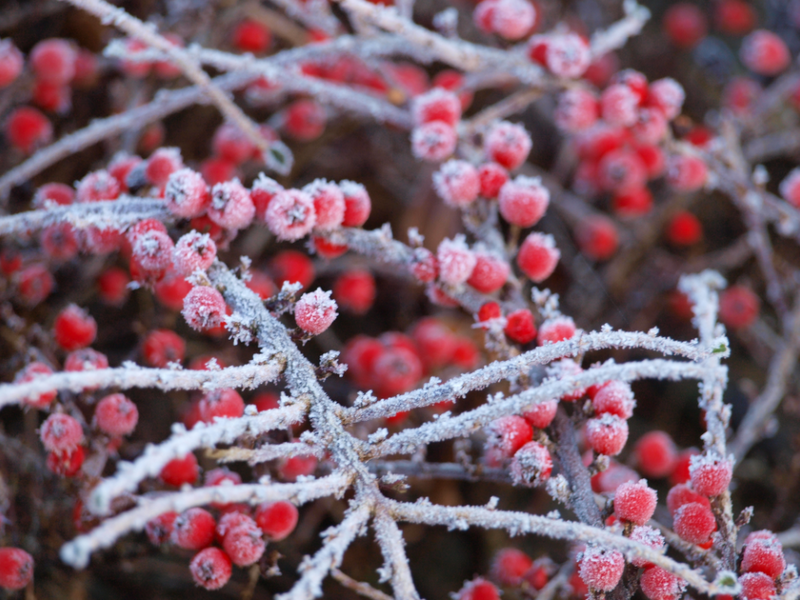
f/5.6; ISO 200; 1/60 second; focal length 150mm


This second image was taken at a much closer distance. Immediately the colour is more noticeable, as is the texture of the frost on both berries and branch. The photograph has a lot of depth looking into the bush and the aperture speed of f/5.6 means that there is a mixture of berries both in and out of focus. A larger depth of field (minimum aperture) would have more in focus, but this may have proved distracting. The central rectangle (see below) ensures that the eye remains within the photo, rather than wandering off, whilst the glimpses off things in the background adds interest to the image. I am very satisfied with this image. It could easily be used as the picture for a Christmas card!


It is also interesting to compare this to images of the same bush taken in September:


I much prefer the winter image with no leaves. Both sets have very different textures – the cold, sparse yet fine and intricate beauty of the frost compared to the luscious and soft fruit and succulent leaves of early autumn.
I am certainly seeing and understanding more of my garden via the camera.

Thursday, 12 January 2012

Use of log feeder as a prop to take 'natural' photographs

This is the log feeder I purchased to be a 'prop' for my photographs of birds.


It consists of a hollowed out log, solid at the bottom, with a lid. In the sides are 6 large holes into which suet, fat, peanuts etc can be 'stuffed'. The inside of the feeder can be filled with peanuts.


The image produced can be as below:


With cropping of the edges where the hanging string is showing this can then be portrayed as a natural log with the bird feeding.


Ideal for the photographer.


However this is far from ideal as a feeder. The size of the holes is such that suet balls have to be demolished in order to fit. Without the suet any nuts within the cavity simply fall out too easy whilst being carried!! In addition it is very inefficient in terms of quantity of food being available compared to my wire feeders. (below).


If the purpose of a feeder is literally to feed as many birds as possible the wire feeder wins hands down.  It is also more durable than the log feeder which if left out for months in inclement weather will probably fall apart and rot. ( In a few weeks the string has already broken!!)


The log feeder will be kept safely for the purpose of photography alone.

Thursday, 5 January 2012

Photographs taken during the Winter Break


During the break from the end of December 2011 to early January 2012 I planned to take many photographs of birds and animals in my garden. I intended several shoots:
·         Patio feeder, both close up and wider angle to catch bird movement and interaction
·         Log specially drilled to enable suet, fat and nuts to be placed in the holes – to give close ups and more natural shots of birds such as Greater Spotted Woodpecker
·         Birds feeding on the ground below the feeders
·         Pheasants and larger birds feeding on the compost heap
·         Squirrels feeding on the lawn, beneath trees, or on feeders
Over Christmas I was away so could do no garden shoots, and indeed the weather was so inclement in Cumbria I did not venture outdoors!
Upon my return home I had 6 days before I returned to work. Surely lots of time to take some interesting photos! Well, ‘best laid plans...’ my friends... For much of the time the weather was dull and damp, with insufficient light to enable my photographing birds in action. I needed good light so that I could have a reasonably low ISO – preferably 100 – 200, but 400 at a pinch. I planned to use a wide aperture to allow maximum light in to the lens, which hopefully would allow a fast shutter speed to give clearly focused images.
I did manage to take photographs on 3 days:
December 30th.
I hoped to take photographs using the camera set on the tripod with the wireless remote to trigger the shutter. The camera was set up in my bedroom, overlooking the patio feeder. Whilst setting up, with reasonable light, the feeder attracted robins, a variety of tits and finches, nuthatches and pigeons. Once set up the birds all became incredibly shy and the only result is shown below.
Photo of 2 house sparrows taken at 11.30am


f/5.0; ISO 400;1/60th second; focal length 202 mm

I find this a most pleasing image. The colours complement each other without being dull. The 2 birds are in focus, and each one sits approximately on a 'Rule of Thirds' intersection. The fact that both birds have been caught with their heads 'up' adds an interesting dynamic to the picture as they appear to be 'looking at' each other, enhanced by the fact that the visible eye of the upper bird is in clear focus. The circular nature of the feeder helps to keep the eye focussed onto the photo; the background is mainly pleasantly out of focus and is no distraction. The upright post which is nearly in focus also is no distraction - the colours do not distract, the lack of focus does not irritate the eye, and the vertical line helps to pull the eye from the top bird down to the paler seeds within the feeder, and thence round to the lower bird. Sparrows as a subjct matter might sound 'dull', but in fact when viewed closely these are most attractive and subtly colured birds. Finally the perspective is unusual in that I am looking down on the birds - very uncommon. The other advantage of this perspective is that the shape of the feeder becomes softer than when viewed sideways on (when it is a rectangular shape).

The time of day is important. The amount of light available during midwinter is obviously limited. Midday light is often optimal to maximise the amount of light. In addition it is a 'gentle' light (compared to that of midday in midsummer) with no harsh shadows.
December 31st.

This was quite a dull day - low cloud and overcast. Since the photos taken of the patio feeder from my bedroom had resulted in only one success, and a possible 'spooking' of the birds, I decided to take images with the camera outside, again with the wireless remote shutter. The tripod was situated approximately 14 feet from the feeder, facing East.  I chose this because the background was a beautifully out of focus green of distant shrubs. The alternative was to have the house in the background - red bricks and white windows; a definite distraction.


The images were taken about 2.00 pm -ish
f/5.6; ISO 400; 1/60th second; focal length 300 mm


The photographs below were taken at the same time, and are of the birds in motion. A shutter sped of 1/60th second is too slow to capture and freeze this motion. This would be an interesting shot of this feeder, but unless the light is very bright I would need to use a high ISO of possibly 1600. This would lead to a very grainy picture which I would prefer to avoid.


January 2nd
January 2nd was the only sunny day of the whole winter break, and I decided to take photographs of the patio feeder. Once more the remote shutter release was used.
Initially I placed the tripod much closer ( approximately 5 feet away), facing South.


f/5.6; ISO 400; 1/125th second; focal length 300 mm

Since I felt these images were being overexposed by the highlights from the sun I moved the tripod back to its position of December 31st, angling the tripod so that no direct sun was entering the camera. 

Taken around noon:
f/5.6; ISO 400; 1/160th second; focal length 300 mm


Certainly the highlights are less noticeable, but are still present.  This might become a positive feature to highlight the bright colours of the birds. 


Finally I moved the tripod into a more sheltered area, to take photographs of the log feeder.
The tripod was on the front lawn, with the camera facing South about 6 feet from the feeder. The log feeder was attached to a tree between the 2 lawns ( see later blog).

Taken around 12.30
f/5.0; ISO 400;1/80th second; focal length 169 mm


This has produced some varied and fascinating images. Pictures of the great tits and nuthatches look very natural; those of 2 birds feeding would be fascinating if bothe birds were within shot; and at last images of the woodpecker - but not completely in shot! How frustrating.
I shall need to narrow the feeding area so that the birds only appear within the target area, and possibly that area needs widening. The method obviously works, and with time, patience and opportunity I feel confident that I can take those desired images of woodpeckers.

Wednesday, 4 January 2012

Mushrooms in the sleet

Currently the garden has an abundance of mushrooms in one area of the lawn. On December 18th I took some photographs trying to emulate the image by Paul Strand which I much admire.


Below are the images taken:


Dull aren't they? This is partly because of the lack of light such that there is no vitality in the colours. However the perspective is still not correct. I was on hands and knees as close as possible but still I am looking from above, whereas Paul Strand is almost at eye level with the fungus so that we can see beneath it. This is obviously another shot where I need to practice and be innovative.

Ansel Adams

Ansel Adams (1902 - 1984) is considered by many to be America's greatest landscape photographer. He was influenced by Paul Strand which gave rise to an interest in 'pure' photography. His photographs are characterised by use of a small aperture to give pin point clear images with a great depth of field.He was also knowledgeable on the science of photography, creating in 1941 the 'zone system' which was an aid to determine correct exposure and development times.
He is most famous for his photographs of the beauty of his native North America but was also a keen photographer of trees, often producing striking black and white images.

The images I show below are copied from:

Ansel Adams. Trees. The Trustees of the Ansel Adams Publishing Rights Trust. 2004. Little Brown and Company, New York. ISBN 0-8212-7752-9

Page 9.

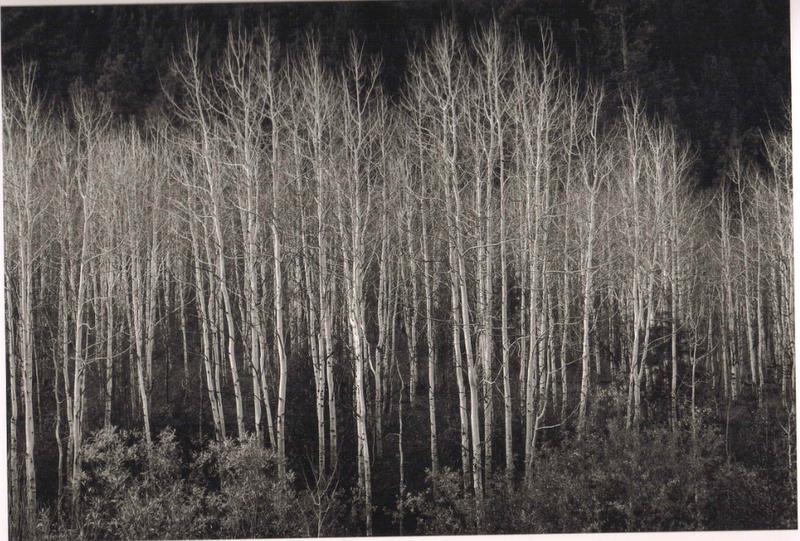
Aspens, Northern New Mexico. 1958.

This photograph was taken “on a crisp autumn day in the mountains north of Santa Fe ... We were in the shadow of the mountains, the light was cool and quiet and no wind was stirring. The aspen trunks were slightly greenish and the leaves were a vibrant yellow. The forest floor was covered with a tangle of russet shrubs. It was very quiet and visually soft ... I visualised the images as stronger, in accord with the mood of the hour and the place.”  (Ansel Adams, from ‘Examples: The Making of 40 Photographs’.)

Page 97

Aspens, Dawn, Delores River Canyon, Colorado. 1937


Page 13

Road and Fog, Del Monte Forest, Pebble Beach, California. 1964


The common denominator for me of all these images is the sheer vertical uprightness of all these trees. I suspect the maximum lean is 5 degrees. Add this to the use of black and white gives a solidity and strength to all the images.

The 3 images are tremendously varied. On Page 9 the softness of the shrub is shown not only by the presence of leaves highlighted dramatically in the light but the contrasting  'round' shape. The visual tone is immense from the near black of the forest to the almost white of the leaves. When you read Adams' comments you realise that he has enhanced thisphotograph to create an image more in keeping with moonlight and nighttime.  An image of power.

The second image on Page 97 appears softer to me. The dawn light has caught most of the aspens, although hints of more can be seen in the background. The trees draw you in to the forest - they do not appear harsh or threatening. This effect is because of the bright dawn sunlight - probably 30 minutes later and the image would be flatter as more trees were illuminated, possibly with a background.

The third image in the fog is softer again. The image is more 'open'; the track leads you into the image to see what is beyond the bend. The fog adds a softness which bright sunlight could not although the image is far from dark, and totally non-threatening. The obscurity caused by the effect leaves you questioning - what is down the track, amongst and beyond those trees.

In order for the images to work in black and white they must have sharp lines and shapes - which is certainly the case. However Adams' great strengt is his use of light to evoke mood.


I am also showing an image of my own, taken on an autumn afternoon.


f/16; ISO 200; 1/80 second; focal length 40 mm

How does my image compare? Well there are many differences:
     fewer trees
     less upright with deeper angles
     colour not black and white
     closer
     more cluttered

However I believe the influence can be seen. Certainly after seeing such images by Adams I became more aware of trees as shapes - especially vertical lines. Possibly a wider lens may improve the image by including the tree tops (my wide angle lens is currently faulty); possibly I could shoot from a lower perspective to give a greater impression of height. The garden itself limits the distance from which I can shoot any image. The light is harsher than that used by Adams, and yet the gradations of colour from near violet to blue within the sky gives a beauty of its own.
Technically a lower ISO (100) and smaller aperture (f/22) to maximise depth of field would also improve the image. The use of a tripod to enable use of the slowest possible shutter speed might have enabled this.

This image is not the finished article, but gives a direction in which to travel.